Summary: Statistical process control techniques help factories monitor production quality using data-based systems. The blog explains how control charts, variation tracking, and early defect detection improve manufacturing efficiency across production lines. It shows how teams adjust machines using statistical signals and maintain quality across shifts. It also covers cost reduction, real-time monitoring, and integration with modern systems. The content highlights how structured analysis supports stable output and better decision-making in industrial operations across multiple sectors.
Modern factories rely on statistical process control techniques to monitor production output with real-time data tracking. These methods help engineers identify small shifts in process behavior before they turn into major quality issues. Control charts, variation tracking, and sample checks support decision-making across production lines in automotive parts, electronics, FMCG units, and heavy machinery setups. The main goal is to keep process output consistent across every shift. In many plants, sensors collect data from machines every few seconds. This data helps teams see how production is moving. Even a small change in speed, heat, or pressure can affect final product quality. Statistical systems help catch these small changes early.
Control Charts Inside Production Lines
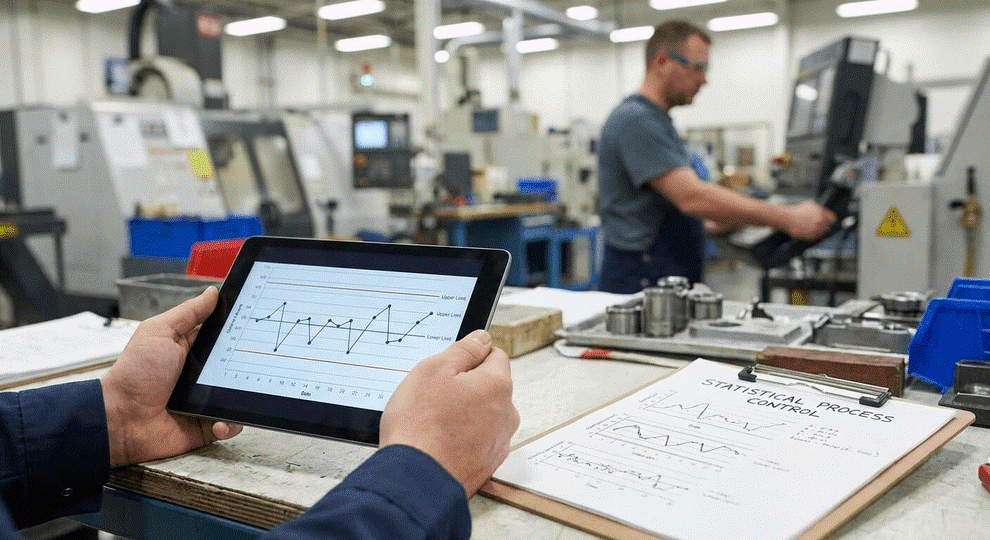
Control charts act as a live tracking tool on factory floors. Operators use them to compare current output against defined limits. If values move outside expected limits, the system flags them for review. This helps teams act quickly instead of waiting for final inspection results. It reduces defective output and supports smoother workflow across machining, assembly, and packaging units.
These charts are often displayed on screens near machines. Workers can see if the process is stable or not. Green signals show stable output, while warning signals show a need for attention. This simple visual system helps teams react fast without confusion.
Variation Tracking for Process Behavior
Every production system has natural variation. The focus of statistical process control techniques is to separate normal variation from abnormal variation. Engineers study patterns in temperature, pressure, speed, and material flow. This helps identify whether issues come from machines, raw materials, or human handling. Once the source is clear, corrective steps become more accurate and faster.
For example, if a machine starts producing slightly different sizes of a part, statistical tracking can show if the change is random or linked to tool wear. This avoids guesswork and improves accuracy in fixing problems.
Early Defect Detection at the Source Level
Factories use sampling methods to detect defects at early stages. Instead of checking only finished goods, inspection points are placed at multiple stages. This approach reduces rework and prevents defective batches from moving further in the system. It also supports better resource planning since problems are identified closer to their origin.
This step is important in high-volume production. Catching defects early saves time, material, and machine effort. It also helps maintain steady output without sudden stoppages.
Process Adjustment Using Statistical Signals
Production teams rely on statistical indicators to adjust machines and workflow settings. If output shows drift from standard limits, operators modify speed, alignment, or input mix. These adjustments are not random. They are based on structured statistical signals, which increases consistency across long production runs.
This system also reduces overcorrection. Instead of making large changes, teams make small controlled adjustments. This keeps the process stable and prevents new errors from forming.
Quality Stability Across Multiple Shifts
Large manufacturing units run across multiple shifts. Statistical process control techniques help maintain uniform output quality across all shifts. Data from one shift is compared with others to ensure no hidden variation is introduced due to staffing or machine differences. This keeps production aligned with required specifications.
Shift handovers become more structured because data is carried forward. The next team can see exactly what happened before and continue without confusion. This improves continuity and reduces miscommunication.
Reduction of Cost Through Process Control
Uncontrolled variation leads to scrap, rework, and downtime. Statistical monitoring reduces these losses by identifying issues early. This improves material usage and reduces machine stress. Over time, it creates a stable production environment with fewer interruptions and better output control.
Factories also save costs by reducing inspection load. Since the process is already monitored, fewer final checks are needed. This improves overall efficiency and supports better use of manpower.
Integration With Modern Manufacturing Systems
Factories now combine statistical tools with digital monitoring systems. This integration allows continuous tracking of process data and faster reporting. Engineers can analyze trends without delay and respond to changes in production conditions in real time.
These systems often store historical data. This helps teams compare current performance with past performance and find long-term patterns. It also supports better planning for future production cycles.
Decision Support for Production Teams
Supervisors use statistical reports to make production decisions. Instead of relying on manual observation, they depend on charts, deviation reports, and trend analysis. This improves decision accuracy and reduces uncertainty in daily operations.
This approach also helps train new staff. Visual data makes it easier to understand what stable and unstable production looks like. Teams can learn faster and perform better on the shop floor.
Role in Continuous Improvement Programs
Continuous improvement programs rely heavily on statistical process control techniques to measure progress. Each improvement cycle is tracked using data, ensuring changes deliver real results. This supports structured growth in production efficiency and product quality.
Small improvements are tracked step by step. This helps teams understand what works and what needs correction. Over time, this builds a stronger production system with fewer errors.
Connection With Advanced Quality Methods
Many factories connect statistical control systems with structured improvement frameworks such as Six Sigma in business process optimization. This combination strengthens defect reduction strategies and improves long-term production consistency.
This link also helps teams standardize quality practices across different plants. It creates a common system for measuring and improving performance.
Ending Note:
Statistical process control techniques support factories in achieving stable output, reduced defects, and controlled production flow. These methods give clear visibility into process behavior and help teams respond with data-based actions instead of assumptions. At Statistical Manufacturing Solutions, our focus is to support manufacturers with strong analytical systems that improve factory performance and production control across complex operations. Businesses using structured statistical systems gain better consistency, lower cost impact, and improved operational reliability.
FAQs:
1. What are statistical process control techniques?
They are methods used to monitor production quality using data and charts. They help detect process changes early and improve stability.
2. How do factories use control charts?
Control charts track production output against limits. They help operators identify issues quickly and take corrective action.
3. Why is variation tracking important in manufacturing?
It helps identify whether changes come from machines, materials, or operations. This improves root cause analysis.
4. Can SPC reduce production cost?
Yes, it reduces scrap, rework, and downtime. This leads to better material use and lower operational costs.
5. Is SPC useful for large factories? Yes, it supports multiple production lines and shifts. It ensures consistent quality across complex operations.
Recent Comments